
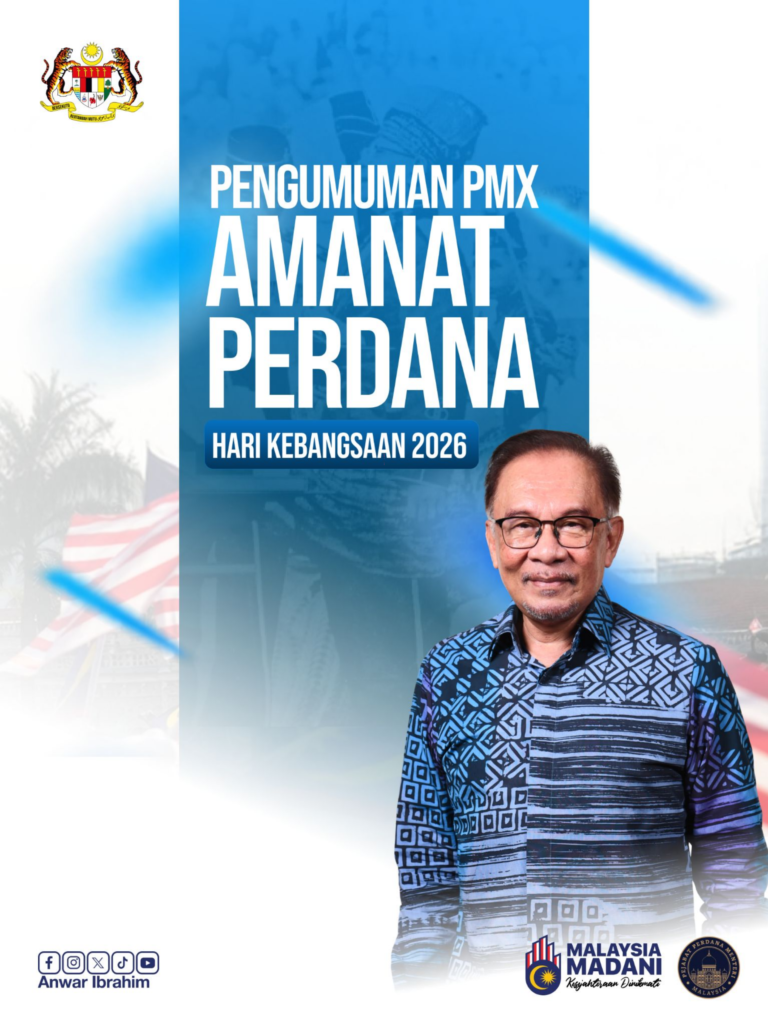
As Malaysia approaches Budget 2027, I have been reflecting on the recent National Day announcements by our Prime Minister, YAB Dato’ Seri Anwar Ibrahim.
In my personal view, they cover very different areas: expanded BUDI MADANI support, which is the happiest news to all the rakyat, RM1.5 billion for school maintenance in 2027, AI access for 100,000 young Malaysians, RM1 billion for digitalisation of public healthcare, a higher e-Invoice exemption threshold, and additional support and financing for small businesses.
It looks fragmented, but if to study carefully as one, I believe they reveal something more important about the direction Malaysia is taking. It is not simply about spending more, but leaning towards protecting people while transforming the economy.
And this is exactly where the sustainability conversation needs to go next.
The next stage of ESG cannot be policy alone
Malaysia has made significant progress in building its sustainability architecture.
We have the National Sustainability Reporting Framework (NSRF), based on IFRS S1 and IFRS S2. In 2027, ACE Market issuers and large non-listed companies with annual revenue of RM2 billion and above will join Group 1 and Group 2 of public-listed companies in the implementation of the framework.
At the same time, SSM has consulted on the Proposed Amendments to the Companies Act 2016 [Act 777] on Sustainability Reporting, potentially bringing sustainability reporting into a much broader segment of corporations in Malaysia over time.
Under the current proposal, non-listed companies with revenue of RM1 billion – RM2 billion or at least 500 employees would enter from 2028; those with RM100 million – RM1 billion or 250–499 employees from 2030; and those with RM15 million – RM100 million or 100–249 employees will join the journey from 2032.
This is a significant evolution, but it raises a question that I believe deserves as much attention as the regulations themselves:
Are we building companies’ capacity fast enough to meet the policies we are creating?
For me, this should become an important part of the Budget 2027 conversation.
Because a reporting deadline should never become the starting line
There is a danger in sustainability transformation when we focus heavily on frameworks, standards, policies, and disclosure requirements but underestimate what implementation looks like within an actual company.
A company cannot suddenly produce decision-useful climate information simply because a regulation requires it. The departments have to come together and take charge, from data ownership to compilation. It makes clear to the company that internal controls have to be developed with evidence.
Climate risk has to be connected to business risk. Ultimately, the CFO and board need to understand what sustainability means in financially, not only how it should appear in a sustainability report.
Interestingly, SSM’s own consultation identified this challenge. Smaller entities showed substantial capability constraints, while stakeholders expressed high demand for capacity building, financial incentives and sector-specific guidance.
So this is not an argument for less policy. It is yearning for help to ensure that implementation capacity grows together with policy ambition.
From a social-science perspective, this matters even more
Successful economic transitions require legitimacy. People and businesses must be able to see not only what they are required to change, but also how they can realistically make that change. This is why I find the recent announcements particularly interesting.
Malaysia continues to pursue reform and digitalisation, yet the Government has also increased targeted assistance and eased the e-Invoice burden for a large segment of smaller businesses. That reflects an important principle:
Transformation must recognise differences in capacity.
The same principle should guide ESG transformation towards business growth.
Let’s put in example, a RM20 million family-owned manufacturer cannot be expected to begin its sustainability journey with the same resources, personnel and systems as a multinational corporation. The objective may be similar, but the pathway cannot always be identical.
This is where “low-hanging fruit” becomes strategically important
Sometimes in sustainability, we make transformation sound more complicated than it needs to be. For many Malaysian companies, the first meaningful steps are not another 100-page policy document. They need something much more practical: establishing and connecting their sustainability information to financial impact.
These may sound basic, but this is how ESG moves from policy into practice and then becomes part of how a business actually operates. Once these foundations are in place, IFRS S1, IFRS S2, assurance, transition planning, and more sophisticated sustainability strategies become much easier to build. Without that foundation, we risk producing better reports without necessarily achieving better business outcomes.
Budget 2027 has an opportunity to close this gap
The Ministry of Finance’s own Pre-Budget Statement points in this direction.
It identifies productivity, innovation, energy transition, AI, talent development, MSME competitiveness, financing, certification, supply chain participation, and sustainable development as important priorities for Budget 2027. It also specifically asks what support local companies need to compete regionally and globally.
RMK13 goes even further. It calls for greater access to green financing and specifically identifies the need to strengthen SME capabilities to develop viable green projects that can secure financing. There are also programmes supporting energy efficiency, renewable energy, waste management and low-carbon technologies.
I believe this is precisely the opportunity, and the next step could be to scale serious sustainability capacity building, particularly for mid-sized businesses and SMEs that sit inside the supply chains of larger Malaysian and multinational companies.
Be practical; no more just calling awareness or keep introducing simple theory such as “What is ESG?” Move into implementation support; be in their shoes to help companies identify their first five actions and a 90-day plan, and help them understand where sustainability can reduce costs, improve productivity, strengthen resilience, or open new markets.
Because ESG is increasingly becoming an economic competitiveness issue
The landscape has changed and will keep changing; sustainability information is no longer just a governance and assurance issue; it is about competitiveness, market access, and perhaps financing and insurance. The battlefield is real and fierce; it forces businesses to connect not only to financial data but also to business longevity through resilience. History has shown thousands of real cases of businesses disappearing into thin air for failing to adapt to changes in the business landscape.
That is why I believe Budget 2027 should not treat ESG as a separate “green” category. It sits across energy, financing, investment, industrial development, skills, digitalisation, SMEs, supply chains, infrastructure and national resilience. The Pre-Budget Statement itself makes that connection, placing ESG principles alongside strategic investment, energy transition, climate adaptation, digitalisation and national competitiveness.
Perhaps the next question is no longer: “Do we need another sustainability policy?”
The better question may be:
“How do we enable thousands of Malaysian companies to turn the policies we already have into measurable business action?”
Malaysia has done important work in constructing the architecture. The next competitive advantage will come from execution, and execution requires capability.
As we move toward Budget 2027, I hope we can place equal emphasis on the last mile of sustainability transformation, which focuses on helping businesses understand what to do every Monday morning, not only what they need to disclose at the end of the year. Because ultimately: Policies set the direction, but capacity determines whether we get there or we sink. If Malaysia can combine ambitious sustainability policy with practical business implementation, ESG will no longer be seen merely as another compliance requirement. It becomes what it should be, a driver of productivity, resilience and Malaysian competitiveness.
My dear Prime Minister, YAB Dato’ Seri Anwar Ibrahim, I believe this is an opportunity worth considering as Malaysia shapes Budget 2027, particularly as we work to ensure that the sustainability transition reaches not only large corporations but also businesses throughout their supply chains, which will ultimately determine whether Malaysia’s transition succeeds.


